May 01, 2026 · Reflection
The Shape of My Curiosity: What My Chat History Taught Me About My Own Thinking
What a long-running AI conversation archive can reveal — and what it can't. A reflection on the patterns hiding in repeated questions: systems thinking, capability-building, the bridge between strategy and hands-on work, and the quiet pull of earned agency.
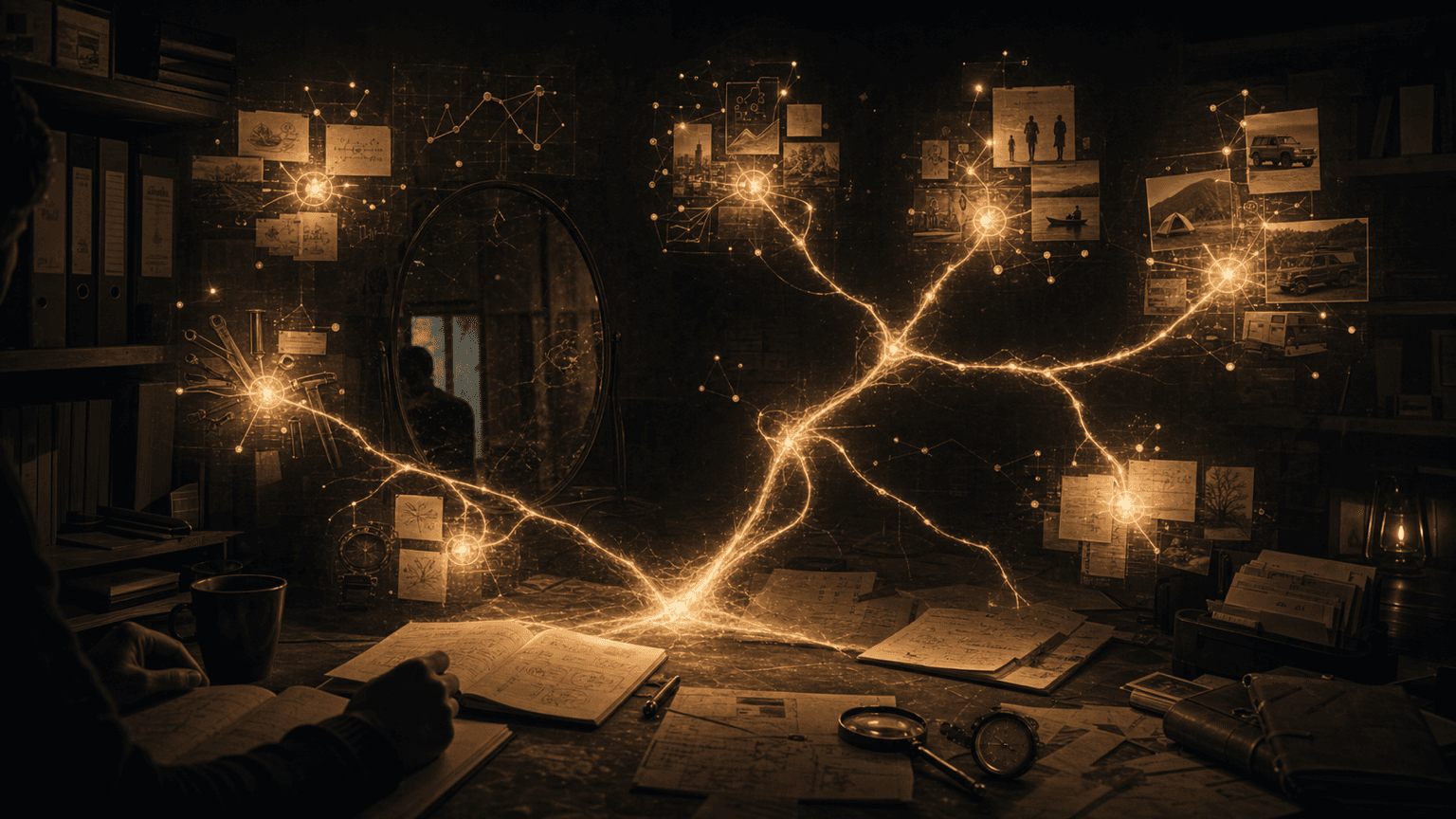
I started using AI for answers, but the archive became more interesting than the answers
I started using AI the way most people do: ask a question, get an answer, move on.
Over time, though, it became something else. Not a diary. Not a therapist. Not a second brain in the polished productivity sense. More like a workshop bench covered in notes, sketches, parts, plans, arguments, half-built models, and the occasional tool I forgot I had already made.
At some point, I became more interested in the archive than any single answer inside it.
That was the question I wanted to sit with: if I looked across months of AI conversations, what would the pattern of my questions reveal? Not what I say I care about. Not what my job title says I should care about. What does my repeated attention show?
This sits near older practices like journaling, commonplace books, reflective practice, and the quantified self. The AI angle does not make the idea new. It creates a strange new kind of record: searchable, messy, biased, and full of questions I asked before I had clean language for what I was really asking.
A chat history is not a diary, but it is not nothing either
The honest version is that a chat history is a deeply imperfect mirror.
It does not capture everything I think about. It over-represents what I chose to type into an AI system. It is shaped by the tool, by the tasks AI is useful for, and by the moments where I wanted help making something clearer, faster, or more structured.
So I don't treat it as proof of who I am. That would be too neat.
I treat it as evidence of something narrower: repeated attention. Recurring questions. Problems I came back to from different angles. Tensions I kept trying to resolve. Things I wanted enough clarity on that I bothered to externalise them.
The archive does not say, "this is the whole person." It says, "here are the tracks left by a person trying to think, build, decide, and make sense of things with help."
That is still useful.
My method was simple: look for returns, not highlights
I didn't want to cherry-pick the most impressive conversations. That would turn the exercise into personal branding, which is not very interesting and probably not very honest.
Instead, I looked for returns.
What topics kept coming back? What kinds of questions had the same shape even when the subject changed? Where did I keep asking for frameworks, stress tests, comparisons, plans, diagrams, and decision criteria?
I grouped conversations into rough clusters: AI transformation, software delivery, knowledge systems, leadership, technical tools, home infrastructure, 4x4 and camping systems, health, media, philosophy, and personal growth. Then I looked for the behaviour underneath the topics.
The useful question was not, "what did I ask about?"
It was, "what was I practising?"
That question changed the analysis. A tyre comparison was not only a tyre comparison; it was about traction, risk, snow performance, legal constraints, and remote travel confidence. A post about AI maturity was about making capability visible enough that people can act on it.
The first pattern: I keep turning topics into systems
The clearest pattern was systems thinking. I don't seem to leave topics alone in their original category for very long.
AI adoption becomes an operating model. A knowledge base becomes strategic infrastructure. A personal website becomes a public thinking system. A 4x4 build becomes a mobility, power, shelter, recovery, and information system. Even camping gear turns into a thermal management problem with condensation, fatigue, comfort, and decision quality attached.
That could sound grandiose if overstated, so I want to keep it grounded. I am not saying every topic deserves a system map. Plenty of things are better left simple.
But in the work I tend to care about, the parts interact. Tools change behaviour. Environments shape decisions. Small design choices create second-order effects. A better sleeping bag is not just comfort if I am winter camping alone; it affects recovery, decision quality, and sensible risk the next day.
The same pattern shows up professionally.
When I think about AI transformation, I don't stay at "which tool should people use?" for very long. The more important question becomes: what work changes, what human judgment still matters, what systems need to be in place, and how do we know whether capability is improving?
That is where concepts like AI Fluency, Thinking Altitude, AI Excellence, and Adaptive Operating Model came from. They are attempts to make a messy shift visible enough to discuss without pretending it is simpler than it is.
The second pattern: curiosity usually turns into capability-building
Another pattern was the way curiosity behaves.
A lot of my conversations begin with something fairly simple: "Is this true?" "How does this work?" "What are the trade-offs?" "What would be better?" "Can we stress test this?" But they rarely stay there.
The common arc is:
Notice something interesting.
Ask how it works.
Compare the options.
Build a mental model.
Test it against constraints.
Turn it into a decision, artifact, or next action.
That matters because curiosity can easily remain consumptive. There is nothing wrong with curiosity for its own sake, but the pattern in my archive is more active than that. I keep trying to convert interest into capability.
Sometimes that capability is professional: helping teams adopt AI, explaining operating model change, and assessing whether people are becoming genuinely more effective with AI rather than just busier with AI.
Sometimes it is technical: getting more confident with Codex CLI, GitHub workflows, MCP connectors, Home Assistant, ESPHome, networking, or knowledge systems.
Sometimes it is physical: understanding tyres, recovery gear, fuel constraints, winter sleep systems, vehicle diagnostics, or safer remote camping.
The through-line is not expertise in every domain. It is the urge to become less fragile in the face of complexity.
That is a useful pattern to see, but it has a shadow side. Capability-building can become endless preparation if I let it. There is always one more comparison, one more model, one more piece of gear, one more tool, one more draft.
The archive showed me both sides: real learning, and the temptation to keep refining the map instead of walking the terrain.
The third pattern: I live in the bridge between strategy and hands-on work
The part of the archive I liked most was how often it moved between levels.
One day I might be working on AI operating models for software businesses. Another day I might be debugging a home automation issue, setting up developer tooling, comparing winter tents, or reasoning through the behaviour of a tuned vehicle.
Those sound like different worlds. In practice, they scratch the same itch.
I like the bridge between abstract and practical work. I like when a model has to survive contact with real constraints. I like when a tool is not just explained, but installed, configured, broken, repaired, and folded into a working system.
That probably explains why I am wary of clean professional language that never touches the ground. There is a version of AI transformation writing that sounds impressive but does not tell anyone what to do on Monday morning. There is also a version of tinkering that accumulates parts without a larger purpose.
The place I find most interesting is between those two failure modes.
A good strategy should eventually show up in calendars, repositories, rituals, templates, budgets, measures, and decisions. A good technical project should teach something larger than the tool itself.
The fourth pattern: self-reliance was a deeper thread than I expected
I expected to see curiosity. I expected to see AI. I expected to see systems.
I did not expect self-reliance to show up as strongly as it did.
Once I saw it, it was everywhere. AI fluency is a form of professional self-reliance. Developer tooling is technical self-reliance. The home lab and automation work are infrastructure self-reliance. The 4x4 and camping systems are physical and environmental self-reliance. Health and fitness goals sit in the same family.
This is not rugged individualism. I don't mean "do everything alone" or "never depend on anyone." That is not realistic, and it is not how good systems work.
The better phrase might be: earned agency.
I want to understand enough to make good decisions, ask better questions, avoid helplessness, and know when I need help. I want to participate in the system, not just consume from it.
That shows up in small behaviours. I don't just want to know which tyre is best; I want to understand why. I don't just want to buy a knowledge tool; I want to know whether people will actually use it. I don't just want a polished answer; I want to know whether the reasoning holds up.
Underneath the questions is a repeated attempt to make confidence more earned.
The uncomfortable pattern: AI helps me think, but it can also make too much thinking too easy
The most useful part of this reflection was not flattering.
AI makes it easier for me to think at volume. It helps me structure ambiguity, compare options, challenge assumptions, and turn vague ideas into something visible. That is valuable.
But it also makes it easier to produce more thinking than I can metabolise.
That is the uncomfortable pattern. A good AI conversation can feel like progress because the output is coherent. A framework appears. A table is filled. A memo becomes sharper. A decision tree takes shape. All of that can be useful, but it is not the same as integration.
There is also a cognitive atrophy risk. I have used the analogy before of GPS versus learning the map. GPS is useful. I use it all the time. But if I never build an internal sense of direction, I become dependent on the tool in a way that quietly weakens me.
AI has the same risk.
If I use it to sharpen my thinking, I get stronger. If I use it to avoid the hard part of thinking, I get faster and weaker at the same time.
That distinction is hard to police because the output can look similar from the outside. A strong draft and a substituted draft can both be fluent. A useful framework and a decorative framework can both look structured.
So I need some rules for myself.
I need time where I think before asking. I need to write rough versions unaided. I need to distinguish between "this helped me see something" and "this gave me something that sounds good." I need to track whether ideas turn into action, not just whether they turn into documents.
The archive gave me evidence that AI has become part of my thinking environment. The question now is whether I am using that environment to build strength or avoid strain.
The archive showed me what I return to when nobody is assigning the work
One of the quietest but most useful questions was this: what do I work on when nobody is assigning the work?
The answer was more coherent than I expected.
I return to AI and how it changes work. I return to tools and how they shape capability. I return to systems that make people less dependent on vague intent and more able to act. I return to adventure, self-reliance, and the physical experience of being prepared. I return to personal growth in the basic sense of wanting to become more capable and less avoidant.
That is useful to know because voluntary attention is a signal. It is not the only signal, but it is a real one.
A résumé tells one version of a person. A calendar tells another. A bank statement tells another. A chat history tells a stranger one: what questions kept feeling worth asking?
Mine seems to say that I am drawn to the design of capability.
Not just capability as skill. Capability as a whole environment: tools, habits, knowledge, feedback, physical systems, constraints, and judgment.
That gives me a useful lens for this website. I don't want it to be a portfolio in the narrow sense. I want it to be a place where I publish what I am learning while trying to build useful systems — professional, technical, personal, and physical.
What I would do differently next time
If I were analysing my chat history again, I would be more deliberate from the start.
First, I would separate observations from interpretations. "I asked about AI transformation repeatedly" is an observation. "I am trying to understand how work changes under AI" is an interpretation. Both are useful, but they are not the same kind of claim.
Second, I would tag conversations by the kind of thinking they represent, not just the topic. Was I deciding, exploring, drafting, debugging, comparing, planning, reflecting, or avoiding? The mode might matter more than the subject.
Third, I would track which conversations became action. Which ideas became documents, decisions, builds, habits, purchases, experiments, or conversations with other people? That would help separate productive synthesis from attractive output.
Fourth, I would keep a small set of recurring questions visible:
What am I returning to?
What am I avoiding?
What keeps becoming more specific?
What keeps staying vague?
What did I act on?
What did I only make look clearer?
Those questions are more useful than a dashboard.
A question worth sitting with
I don't think the point of analysing a chat history is to discover some hidden fixed self.
People are more fluid than that. Context matters. Tools shape behaviour. Archives distort. Interpretation adds another layer of distortion.
But I do think the archive can show what we are practising.
That is the question I keep coming back to. Not "who am I?" in the grand sense. More practical than that:
What am I becoming more rehearsed at?
If my repeated conversations are training data for my own attention, then I want to be careful about what I keep training. Am I practising clearer judgment, or faster outsourcing? Am I building earned agency, or just collecting better explanations? Am I turning curiosity into capability, or letting curiosity become a more sophisticated way to defer action?
That is where the exercise left me.
Not with a final answer, but with a better question: look at what you keep asking, what you keep refining, and what you actually change afterwards.
Then ask yourself what all that repetition is teaching you to become.
This post is drawn from my own long-running use of AI as a thinking and drafting environment. It reflects personal analysis and public learning, not a company position or professional advice.