May 07, 2026 · Reflection
The 4x4 as a System: What My Ranger Raptor Has Taught Me About Capability
Notes from using, refining, and learning a vehicle-based adventure system over time. A reflection on tyres, power, recovery, winter camping, and why every improvement has a receipt somewhere else in the system.
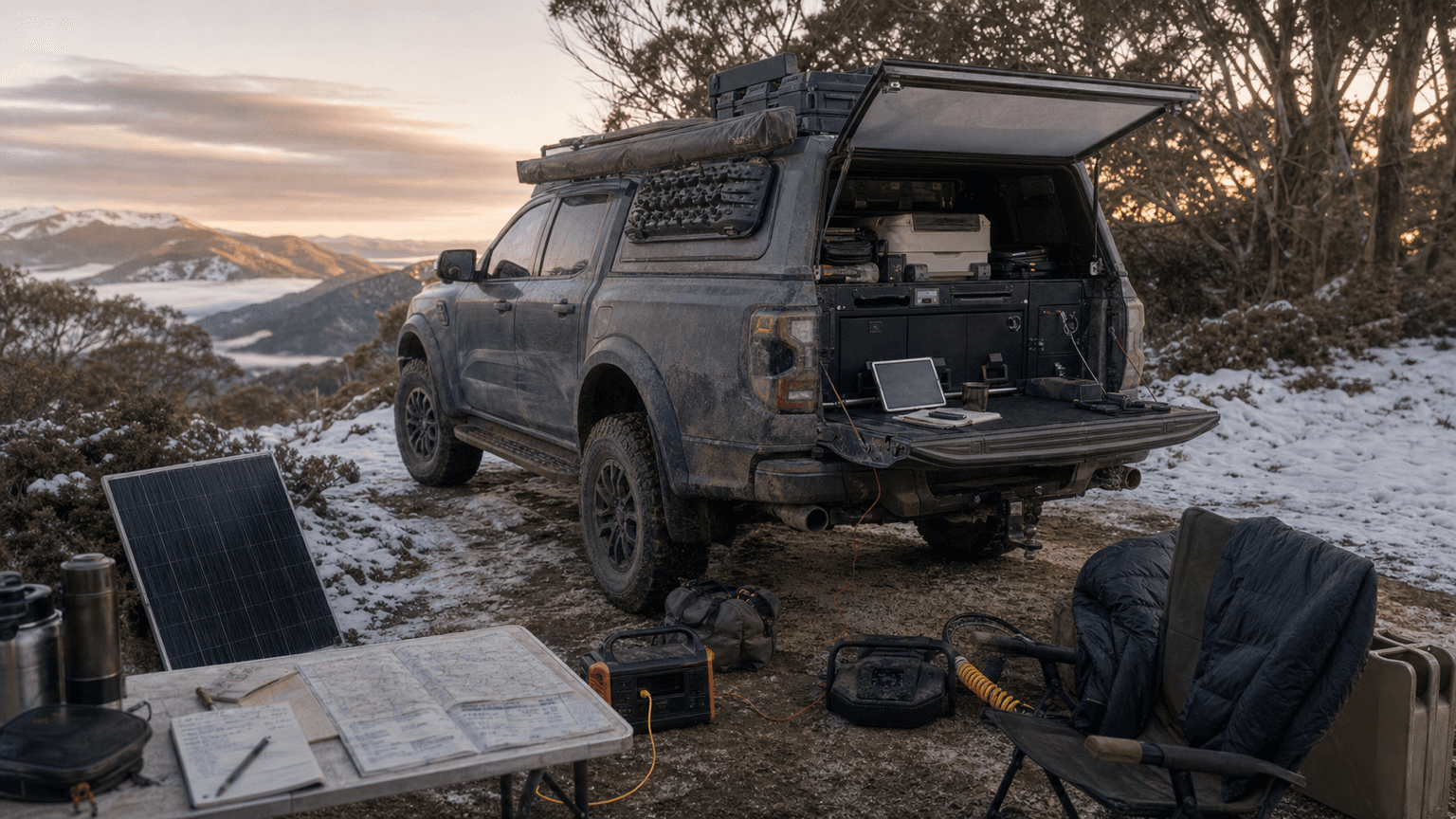
It became a system through use
A 4x4 can look like a collection of parts from the outside: tyres, compressor, recovery gear, tools, maps, wiring, sleeping gear, fuel, food, and whatever else gets bolted on or packed in.
That is not how I experience it anymore.
After using my Ranger Raptor across trips, tracks, weather, solo planning, winter camping, and a long tail of small improvements, I think about it less like a modified vehicle and more like a system I am learning through use. Not a clean theoretical system. A practical one — the kind that reveals itself when you notice what takes too long, what creates friction, what feels sketchy, and what you quietly avoid because the setup is not quite right.
The vehicle is the platform, but the real system includes everything around it: how I prepare, pack, sleep, check conditions, recover, manage power, read the vehicle, and make decisions when I am by myself.
Most of what I am working on now is iterative: safer solo trips, easier winter trips, less setup friction, better storage, cleaner power, and more confidence because the repeated details have been worked through.
Capability is mostly revealed by friction
A lot of build thinking starts with capability in the abstract: better tyres, more clearance, better recovery gear, better storage, better performance, better sleep.
Those things matter, but the more useful signals are often smaller.
What takes too long when I am cold? What gets buried when I need it? What do I double-check because I do not fully trust it yet? What works on a mild weekend but becomes annoying in wind, rain, or winter dark?
That is where the system starts to teach you.
The big failures are obvious. The repeated friction is more interesting. The compressor works, but makes power design more serious. The sleeping setup is workable, but winter margin and condensation still matter. Tyre choice looks simple until size, offset, rubbing, snow rating, and road manners all collide.
The vehicle gets better when I pay attention to those frictions instead of only chasing obvious upgrades.
Tyres taught me that every improvement has side effects
Tyres are one of the clearest examples of how quickly a simple upgrade becomes a system decision.
On paper, bigger tyres are easy to want: more clearance, more sidewall, more footprint, more presence. In practice, the question becomes layered: how much bigger, what construction, what tread pattern, what snow performance, what legal constraints, what rubbing risk, what steering load, what fuel impact, and what happens to the rest of the driveline?
I have spent plenty of time comparing 295/70R17 and 315/70R17 sizes, Mickey Thompson all-terrains and mud-terrains, BFG KO-style tyres, and the more extreme race-tyre end of the spectrum. The main lesson has not been one perfect answer. It has been respect for side effects.
A 315 might add useful clearance and footprint, but it can also add weight, rubbing risk, steering load, fuel use, spare fitment questions, and mechanical stress. A mud-terrain might be better in sloppy conditions, but that does not automatically make it better for wet roads, long drives, snow rating, or daily use.
Even offset has trade-offs. Moving the wheel further out can help inner clearance while changing poke, scrub radius, outer rubbing risk, and steering feel.
Every improvement has a receipt somewhere else in the system. Sometimes it is worth paying. Sometimes it is not.
Power became a system once the loads got serious
Power was one of the areas where the vehicle stopped feeling like a list of accessories.
The air compressor was the first obvious example. Mine runs around 45 amps and can spike to roughly 120 amps on startup. That turns "where do I mount it?" into cable sizing, fusing, connectors, voltage drop, heat, access, and whether the system behaves predictably when I need it.
But the compressor is only one part of it now.
The bigger shift is the EcoFlow battery, alternator charger, and roof-mounted solar panel. Once there is a dedicated battery system in the vehicle, charged from the alternator and topped up by solar, power becomes energy management: what draws from the vehicle, what draws from the EcoFlow, how fast it recharges, what happens on short drives, what solar realistically contributes, and how to avoid building something clever but annoying.
That system supports more than comfort. It keeps devices charged, supports lighting, runs camp loads, and reduces the small battery anxieties that accumulate over a few days. With Starlink, it also changes what remote can mean. The vehicle can become a temporary off-grid work and communications base: somewhere I can camp, check weather and closures, stay reachable, and still do computer-based work when needed.
That is especially useful in winter, when nights are longer, mornings are colder, and convenience matters more than I used to admit.
The lesson is that power is useful only if it is boringly reliable. I want clear roles: the vehicle starts and drives, the compressor does its job, the EcoFlow handles camp and work loads, the alternator charger brings it back while driving, and the solar panel quietly contributes without needing much attention.
The goal is not the most elaborate electrical system I can build. It is useful power with minimal friction: tyres aired up, devices charged, Starlink available when needed, camp running, winter trips easier, and the vehicle still protected as the thing that gets me home.
Recovery is less about the gear list and more about whether I can use it calmly
I have collected and refined recovery gear over time, but I try not to think about recovery as a checklist.
The better question is: if I am solo, tired, somewhere awkward, and conditions are getting worse, can I use what I have calmly and safely?
That changes how I think about storage, access, practice, and decision-making. Gear buried in the wrong place is not really available. Gear I have not practised with is less useful than I want it to be. A recovery option that depends on ideal conditions is not as reassuring as it looks.
Solo travel changes the system again. The margin needs to be different. Track choice, turnaround points, communication, weather, daylight, fatigue, and difficulty all matter more without another vehicle nearby.
I do not want to remove all risk. That is not the point. But I want risk to be chosen deliberately rather than backed into through optimism.
Performance tuning has been a lesson in behaviour, not just power
The performance side of the Ranger Raptor is part of the fun, and I would be pretending otherwise if I left it out.
The 3.0L twin-turbo V6 makes the vehicle interesting in a way most touring platforms are not. I have spent plenty of time thinking about intake flow, intercooler performance, exhaust restrictions, high-flow cats, E85 mixes, boost targets, plug gaps, knock behaviour, fuel pressure, and FORScan logs.
But the more I have played with it, the more I think the useful question is not "how much more can it make?" It is "how does the whole vehicle behave?"
That became obvious with the lower-RPM throttle hesitation I was chasing. The answer was not simply to add more boost or assume more power was better. The hesitation seemed tied to how aggressively boost came in at lower RPM and how the vehicle's torque management responded. Smoothing the low-RPM request made the vehicle feel better behaved.
Power is not separate from traction, transmission behaviour, heat, fuel quality, driver input, and calibration logic. More can be worse if it makes the vehicle less predictable.
That does not make me less interested in performance. It makes me more interested in performance that fits the use case.
Winter camping changed how I think about comfort
The more winter camping I do, the less I think of comfort as a luxury.
Cold, wet, poor sleep changes everything. It changes patience, judgment, risk tolerance, and whether packing up feels calm or rushed.
That is why I have spent so much time thinking about my sleep and shelter setup: swag, stretcher, mattress, sleeping bag, thermal layers, condensation, cold ratings, tent options, and whether a hot tent makes sense as a secondary system.
Some of that is gear curiosity. I enjoy the research. But the practical reason is simple: winter trips are easier when the setup is warm, dry, and low-friction.
A genuinely warm sleeping bag matters. Condensation protection matters. Shelter usability matters. Even small things like where wet gear goes, how fast I can get into bed, and whether coffee is easy in the morning affect the trip.
The insight is not "buy more comfortable things." It is that comfort can support safety and continuity. If a system makes winter trips easier, I am more likely to go, enjoy them, and make good decisions while I am out there.
Information has become part of the kit
I used to think about the kit mostly as physical equipment. Now I include information in that category.
Weather, wind, rain, temperature, track closures, fire rules, campground status, road conditions, fuel availability, offline maps, navigation, and diagnostics all shape the trip. None of that is as visually satisfying as tyres or recovery gear, but it often matters just as much.
This has become especially important for short-notice trips. If I am leaving quickly for the High Country or somewhere else familiar enough to be tempting, I still need current information. Familiar does not mean static.
The same applies to the vehicle. I pay attention to noises, logs, sensor behaviour, tyre pressures, fuel range, and anything that feels different. Not because I want to overthink every trip, but because the vehicle usually tells you things before it fails loudly.
Information does not remove uncertainty. It gives me a better starting point.
The build now is mostly iteration
I do not feel like I am at the beginning of this system anymore.
The broad direction is clear. The next phase is refinement: safer solo trips, easier winter trips, lower setup friction, better storage and access, cleaner power, more familiarity with the vehicle, and performance choices that suit how I actually use it.
Early on, it is easy to think in big categories: tyres, compressor, recovery, sleeping, power, tools, maps. Later, the work becomes more specific. Where should this live? What do I use every trip? What do I never touch? What takes too long? What adds confidence? What adds clutter? What made the last trip harder than it needed to be?
Those questions are less exciting than a big upgrade, but often more useful.
The goal now is not to create the most extreme Ranger Raptor build I can. It is to make the system feel more natural in use: less friction, more margin, better judgment, easier winter trips, safer solo decisions, and more confidence because the repeated details have been worked through.
What the vehicle has really given me
The obvious answer is access.
The Raptor gets me into places I want to be: quiet camps, rougher tracks, winter bush, long dirt roads, and the kind of trips that feel far enough away from normal life to reset something. That is the simple answer, and it is true.
But the less obvious answer is that it has given me a practical arena for learning.
It has taught me that every improvement has side effects. It has made me more attentive to weather, fatigue, and small failure modes. It has made me more interested in the relationship between capability and restraint. It has reminded me that comfort is not always softness. It has shown me that solo travel is not just the same system with one person removed; it needs a different kind of margin.
Most of all, it has made self-reliance feel less abstract.
Not the fantasy version where I never need anyone. The practical version where I understand enough to prepare better, notice earlier, decide more calmly, and recover from more of the small problems before they become big ones.
That is the part I keep coming back to.
The vehicle is fun. The modifications are fun. The research is fun. The trips are the point.
And somewhere in the middle of all of that, the system keeps teaching me what kind of capability I actually value.
This post is drawn from my own Ranger Raptor build, remote travel, winter camping, and ongoing refinements to make solo trips safer and easier. It is personal reflection, not professional advice or a recommendation for how anyone else should modify a vehicle.